No products in the cart.

USE CODE: SPINNERBELT

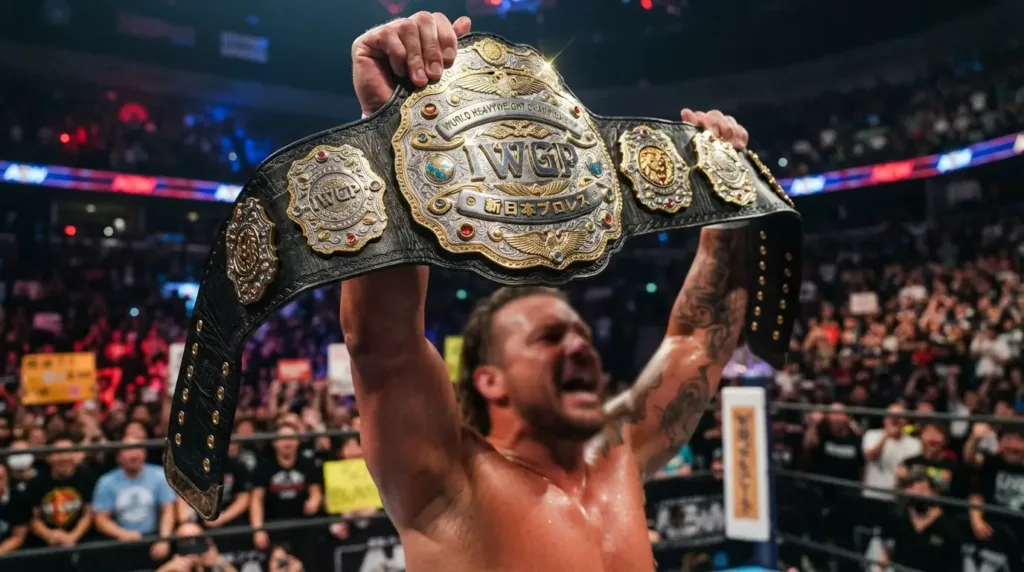
Few championships in professional wrestling carry the prestige of the IWGP Heavyweight Championship. Representing the pinnacle of New Japan Pro-Wrestling (NJPW), the title has passed through multiple lineages, name changes, and design overhauls since it first appeared in the early 1980s.
From Antonio Inoki’s founding vision to a controversial 2021 unification and a surprising 2026 revival, this guide traces the complete history of the IWGP Championship belts and the legends who carried them.
IWGP stands for International Wrestling Grand Prix, the name of NJPW’s governing body. The championship was created to represent this organization’s top prize, positioning it as a title built on legitimate, sport-based competition rather than pure entertainment spectacle — a philosophy pushed by NJPW founder Antonio Inoki.
Before the championship fans know today existed, NJPW ran an earlier version of the IWGP title starting in 1983. This original championship was awarded to the winner of the annual IWGP League, a round-robin tournament featuring wrestlers from promotions around the world, including international heavyweight champions like Otto Wanz and Canek. Hulk Hogan became the inaugural champion in 1983, while Antonio Inoki became the title’s final and only two-time champion before it was retired in 1987. This early version does not share its lineage with the championship that replaced it.
On June 12, 1987, NJPW introduced a new version of the IWGP Heavyweight Championship, with Antonio Inoki becoming the inaugural champion after winning that year’s IWGP League tournament final. Unlike its predecessor, this version was defended regularly as a traditional championship rather than purely through annual tournaments, and it went on to become the most prestigious singles title in Japanese professional wrestling for over three decades.Throughout its 34-year history, the title was held by a roster of legendary names, including Tatsumi Fujinami, Keiji Muto (as Great Muta), Masahiro Chono, Shinya Hashimoto, Big Van Vader, Shinsuke Nakamura, Hiroshi Tanahashi, Kazuchika Okada, Tetsuya Naito, Kenny Omega, AJ Styles, and Kota Ibushi. Okada’s fourth reign, which lasted 720 days, is widely regarded as one of the most dominant championship runs in modern wrestling history.
The championship’s history also includes several notable unifications and controversies. In 2003–2004, NJPW merged the previously separate NWF Heavyweight Championship into the IWGP lineage after Nakamura defeated NWF champion Yoshihiro Takayama. In 2006, Brock Lesnar was stripped of the title after failing to appear for a scheduled defense, sparking a dispute that led Antonio Inoki to launch a rival promotion, Inoki Genome Federation (IGF), and recognize a separate version of the championship. This split, sometimes called the “IWGP 3rd Belt,” was carried briefly by Lesnar and later Kurt Angle before being reunified with the NJPW-recognized title in February 2008.
Customization is one of the biggest advantages of choosing a premium ECW belt. It allows buyers to create something unique rather than settling for a generic design.
You can personalize the nameplate, adjust the strap style, or choose different finishes for the plates. This transforms the belt from a simple replica into a personal collectible.Most competitors either do not offer customization or provide very limited options. By offering flexibility, this belt meets the needs of collectors who want something special and meaningful.
The first version of the modern IWGP Heavyweight belt was intentionally simple: a large gold centerplate engraved with “IWGP Heavyweight Champion” in bold lettering, reflecting the title’s early emphasis on legitimacy over spectacle.
As NJPW grew through the early 1990s, the belt received a more detailed redesign, introducing intricate engravings, a larger centerplate, and lion motifs that gave the title a more regal appearance. This version was carried by stars like Shinya Hashimoto, Keiji Muto, and Masahiro Chono during NJPW’s rise as a global wrestling power.
By the early-to-mid 2000s, NJPW refreshed the design again, keeping the globe and lion imagery but giving it a sleeker, more polished finish, along with updated side plates featuring the NJPW logo. This version was held by champions including Yuji Nagata and, briefly, Brock Lesnar.
The most recognizable version of the belt debuted in the late 2000s and remained in use until the title’s 2021 unification. It featured a massive gold centerplate with bold lettering, detailed lion engravings, a prominent globe, and a distinctive red leather strap that set it apart from most other world titles. Carried by Hiroshi Tanahashi, Kazuchika Okada, and Kenny Omega during NJPW’s golden era of international expansion, this design became synonymous with the company’s global rise and remains a favorite among long-time fans and collectors.
On March 1, 2021, NJPW announced the unification of the IWGP Heavyweight and IWGP Intercontinental Championships into a new title: the IWGP World Heavyweight Championship. Kota Ibushi, the reigning champion of both titles at the time, became the inaugural champion after the new belt was revealed on March 30, 2021. The redesigned belt moved away from the classic lion-and-globe motif entirely, introducing a mixed gold-and-silver design on a black leather strap. The new design drew significant criticism from fans and wrestling media, many of whom felt the unusual centerplate shape looked out of place compared to the beloved red-strap version it replaced. Notable champions of this title included Will Ospreay, Kazuchika Okada, Tetsuya Naito, and Jon Moxley, whose April 2023 win in Chicago marked the first time the title changed hands outside Japan.
In a surprising turn, NJPW revived the classic IWGP Heavyweight Championship at the start of 2026. After defeating reigning IWGP World Heavyweight Champion Konosuke Takeshita at Wrestle Kingdom 20, Yota Tsuji declared he would be recognized as IWGP Heavyweight Champion rather than continuing the World Heavyweight lineage, referring to the newer title as cursed. NJPW honored this request, reactivating the original Heavyweight and Intercontinental Championship lineages and merging them with the World Heavyweight Championship’s history. As a result, every wrestler who had held the World Heavyweight title was retroactively recognized as a former IWGP Heavyweight Champion, restoring the prestige of the title’s original red-strap legacy.
Beyond the top singles title, NJPW’s championship lineup includes several other notable belts. The IWGP Tag Team Championship has been contested by legendary duos since the 1980s, while the IWGP Junior Heavyweight Championship showcases the promotion’s celebrated cruiserweight division. The NEVER Openweight Championship represents a grittier, hard-hitting style of competition, and the short-lived IWGP United States Heavyweight Championship was eventually retired in favor of the IWGP Global Heavyweight Championship, introduced in January 2024 as a title open to challengers from outside Japan.
Few titles in wrestling carry the reputation of the IWGP Heavyweight Championship. Its history of hard-fought matches, legendary champions, and genuine competitive prestige has made it a benchmark against which other world titles, including WWE’s own championships, are frequently compared by fans and critics alike. Even through controversial redesigns and complex lineage changes, the title has remained a symbol of excellence in Japanese professional wrestling for decades.
Explore our full collection of authentic-style IWGP Championship replica belts, inspired by the title’s most iconic eras, from the classic red-strap design to the modern World Heavyweight and Global Championship styles.
IWGP stands for International Wrestling Grand Prix, the name of NJPW’s governing body that the championship was created to represent.
Antonio Inoki became the first champion of the modern IWGP Heavyweight Championship on June 12, 1987, after winning that year’s IWGP League tournament final.
NJPW unified the IWGP Heavyweight and IWGP Intercontinental Championships into a new IWGP World Heavyweight Championship in March 2021, at the request of then-champion Kota Ibushi.
Yes. In January 2026, NJPW revived the classic IWGP Heavyweight Championship lineage after champion Yota Tsuji requested recognition under the original title rather than the World Heavyweight Championship.
From its origins in the 1983 IWGP League tournament to its most recent revival in 2026, the IWGP Heavyweight Championship’s story is one of the richest and most complex in professional wrestling. Each redesign and unification reflects a different chapter of NJPW’s evolution, while the legendary champions who carried it, from Antonio Inoki to Kazuchika Okada to Yota Tsuji, helped build its reputation as one of the most prestigious titles in the sport. Despite controversy along the way, the IWGP Championship’s legacy remains firmly intact, continuing to represent the very best of Japanese professional wrestling.
 Optimized by Seraphinite Accelerator