No products in the cart.

USE CODE: SPINNERBELT

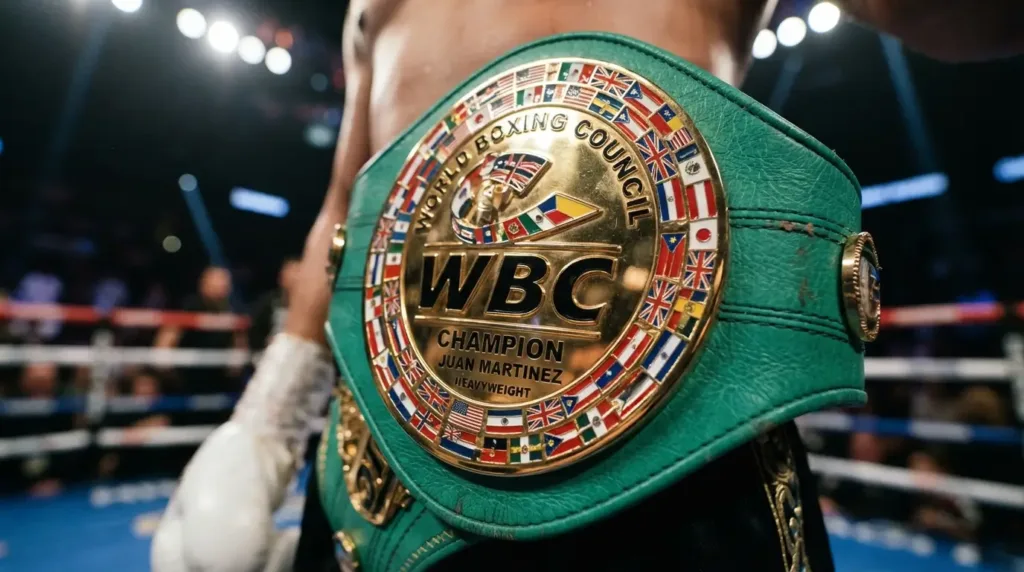
The history of WBC Championship belts traces the evolution of one of boxing’s most instantly recognizable symbols: the iconic green-and-gold strap. Since the World Boxing Council was founded in 1963, its championship belt has gone through six major design generations, each adding new layers of prestige and craftsmanship.
This guide covers the complete design evolution, the different types of WBC belts that exist today, and how the WBC compares to boxing’s other major sanctioning bodies.
The World Boxing Council was established in 1963, quickly building a reputation as one of boxing’s most prestigious and strictly governed sanctioning bodies. In its earliest years, WBC champions weren’t even awarded a belt at all — they received trophies shaped like globes. The organization introduced its first true championship belt shortly after, featuring a simple black leather or satin strap with a silver medallion, a modest design compared to the elaborate belts fans recognize today.
The history of WBC Championship belts includes six major design generations, each reflecting the organization’s growing global reach and reputation.
The original WBC belt used a black strap and silver medallion, a far cry from the green-and-gold color scheme that would later come to define the title.
In 1976, the WBC unveiled the design that would cement its identity: a green leather strap paired with gold-plated plates, establishing what’s now famously known as boxing’s “Green and Gold.” Champions who wore this iconic version included Larry Holmes, Sugar Ray Leonard, Carlos Zárate, and Alexis Argüello. The green strap was chosen deliberately to symbolize freshness, growth, and the ongoing pursuit of excellence in the sport.
Subsequent redesigns introduced increasingly detailed craftsmanship, including ceramic figures added to the belt’s plates to honor the sport’s greatest champions. The fifth-generation belt notably includes ceramic likenesses of former WBC president Don José Sulaimán, Floyd Mayweather, and the reigning champion of the relevant weight division on one side, alongside two legendary champions chosen for that specific weight class and a tribute to Muhammad Ali on the other.
Today’s WBC Championship belt represents the culmination of more than six decades of refinement. Its green center strap portrays the flags of all 161 WBC member countries, with the flags of the organization’s original 12 member nations displayed prominently around a gold center-plate depicting a boxer raising his arm in victory. Described by the WBC itself as a masterpiece of sports jewelry, the modern belt is considered far more than a title — it’s a tribute to the passion, sacrifice, and determination behind every boxer’s journey.
No overview of the history of WBC Championship belts is complete without covering the organization’s several title types one by one. The WBC doesn’t award just one kind of belt — over the years, it has introduced multiple championship tiers, each serving a different purpose within the sport.
This is the organization’s primary, full world title, awarded to the recognized champion of each weight division. It remains the most prestigious belt in the WBC’s lineup and the one most closely associated with boxing’s biggest stars.
Created in 2009, the Diamond belt is an honorary title awarded to the winner of a historic matchup between two elite, high-profile boxers, rather than being tied to a specific division’s regular title picture. It was first awarded to Manny Pacquiao in November 2009 after his win over Miguel Cotto. Unlike a standard world title, defending the Diamond belt isn’t mandatory, and it can be vacated due to a fighter’s retirement or extended absence from the sport.
Introduced in 2010 as an alternative to the Interim Championship, the Silver title was first won by Justin Savi that same year. Unlike an Interim title, a Silver champion does not automatically inherit the full world championship if it becomes vacant, making it more of a stepping-stone title used to build rankings and set up future world title fights.
One of the WBC’s more controversial creations, the Franchise title was introduced in 2019 and first awarded to Saul “Canelo” Álvarez. Unlike other belts, a Franchise Champion cannot lose the title through defeat in the ring — if another fighter beats them, that opponent instead receives the WBC Diamond belt along with an immediate mandatory shot at the full WBC world title, which is passed to the promotion’s reigning interim champion.
Like similar titles across other boxing organizations, the WBC Interim Championship is awarded when a reigning world champion is unable to defend their title due to injury, legal issues, or other circumstances. Once the original champion returns, a unification bout typically follows, with the winner recognized as the undisputed titleholder.
Established in 1986, the International title gives boxers pursuing a career within the WBC system a way to build recognition and secure a favorable position in the organization’s world rankings, functioning as a stepping stone toward full world championship contention.
While both are among boxing’s “Big Four” sanctioning bodies, the WBC and WBA differ in several key ways. The WBA, founded in 1921 as the National Boxing Association before being renamed in 1962, is the older of the two organizations and frequently recognizes multiple champions within a single division, using titles like “Super Champion” and “Regular Champion.” The WBC, by contrast, generally maintains a stricter single-champion policy per weight class, which many fans and fighters believe adds to its prestige. Visually, the two are easy to distinguish: the WBC’s belt uses its signature green strap, while the WBA’s title features a black-and-gold design.
Explore our full collection of authentic-style WBC Championship replica belts, inspired by boxing’s most iconic green-and-gold designs, from classic generations to the modern sixth-generation belt.
This is a common starting point when researching the history of WBC Championship belts. The World Boxing Council was founded in 1963, and while early champions initially received trophies, the organization’s first true championship belt followed shortly after, featuring a black strap and silver medallion.
The famous “Green and Gold” design was unveiled in 1976, establishing the color scheme that remains associated with the WBC Championship to this day.
The WBC Championship belt has gone through six major design generations since the organization’s founding, each adding greater detail and craftsmanship, including ceramic tributes to legendary champions.
The WBC Emerald Championship Belt is a special edition awarded for select high-profile bouts, featuring an especially striking version of the organization’s signature green-and-gold design.
The WBC generally maintains a single-champion policy per weight class, while the WBA often recognizes multiple simultaneous titleholders; the two are also visually distinct, with the WBC using a green strap and the WBA a black-and-gold design.
Yes, authentic-style replica WBC Championship belts inspired by the organization’s iconic green-and-gold designs are available for collectors and boxing fans.
The history of WBC Championship belts reflects more than 60 years of boxing prestige, from a simple black-strap trophy in the 1960s to today’s intricately detailed green-and-gold masterpiece. Carried by legends including Muhammad Ali, Sugar Ray Leonard, Mike Tyson, Floyd Mayweather, and Canelo Álvarez, the belt has become one of the most recognizable symbols in all of sports. Anyone exploring the full history of WBC Championship belts will find that each design generation and title tier tells its own story of the organization’s growth, and today’s belt continues to represent the pinnacle of achievement for boxers around the world.



 Optimized by Seraphinite Accelerator