No products in the cart.


USE CODE: SPINNERBELT

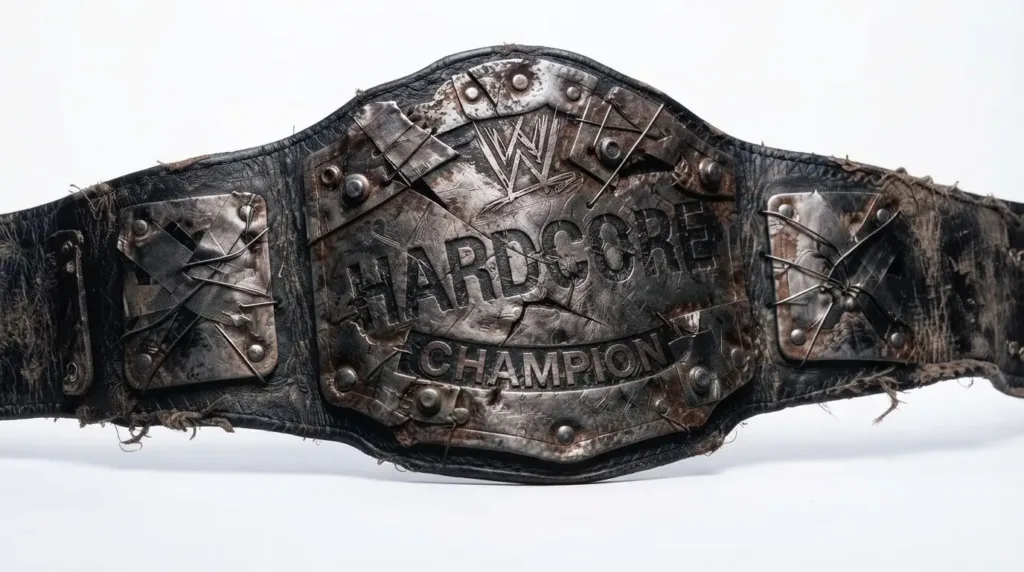
Few championships in wrestling history produced as much chaos as the WWE Hardcore Championship belt. Built around a rule that let anyone challenge for the title anywhere, at any time, this belt became responsible for some of the most unpredictable, wild moments in WWE history.
This guide covers the complete story of the WWE Hardcore Championship belt, from its comedic origins to the legendary “24/7 rule” that defined it.
The WWE Hardcore Championship belt was a title contested under “hardcore rules,” meaning no disqualifications, no countouts, and pinfalls counting anywhere in the arena or beyond. Active from 1998 to 2002, the title became one of the most unpredictable and frequently changing championships in WWE history, eventually producing well over 200 individual reigns during its run.
Vince McMahon awarded the very first WWE Hardcore Championship to Mankind, the alter ego of Mick Foley, on November 2, 1998. At the time of its creation, the title was originally intended as a comedic device, playing off Mankind’s reputation as one of wrestling’s most hardcore, punishment-absorbing performers. As hardcore-style wrestling grew more popular with audiences throughout the late 1990s, however, the WWE Hardcore Championship belt evolved into a genuinely serious title in its own right.
The single feature that made the WWE Hardcore Championship belt so unique was the “24/7 rule,” introduced by Crash Holly on February 22, 2000. Under this rule, any WWE talent could challenge the reigning Hardcore Champion at any place or time, provided a referee was present to make the count. This single change transformed the championship into something never seen before in wrestling: title changes could happen backstage, in parking lots, at airports, or even outside the arena entirely, often with little to no warning. The rule led to the shortest title reigns and the most frequent title changes in WWE history, with the belt regularly changing hands multiple times within a single show.
Because of the 24/7 rule, the WWE Hardcore Championship belt was held by an unusually eclectic mix of Superstars, ranging from Mankind and Crash Holly to Big Show, Hardcore Holly, Big Boss Man, and Kane, among dozens of others. Title changes frequently involved surprise ambushes, roll-up pins, and improvised weapons like kendo sticks, tables, and even barbed wire, with defenses taking place not just across the United States but also in Canada, the United Kingdom, Germany, and Scotland during international tours.
The chaotic 24/7 rule was officially suspended on August 19, 2002, when Raw General Manager Eric Bischoff ended it following a six-minute Hardcore Battle Royal, won by Tommy Dreamer. Shortly after, on August 26, 2002, Intercontinental Champion Rob Van Dam defeated Hardcore Champion Tommy Dreamer, unifying the WWE Hardcore Championship belt with the Intercontinental Championship and effectively retiring the title.
Although officially retired in 2002, the WWE Hardcore Championship belt made a couple of notable, unofficial appearances afterward. On the June 23, 2003 episode of Raw, Mick Foley, the title’s original champion, was awarded the physical Hardcore Championship belt (though not reinstated as champion) by Stone Cold Steve Austin, in recognition of his contributions to hardcore wrestling. In 2006, Foley and Edge also introduced themselves as co-holders of the championship as part of a storyline tied to Extreme Championship Wrestling alumni, though neither of these moments counted as official title reigns in WWE’s records.
The chaotic spirit of the WWE Hardcore Championship belt didn’t disappear entirely after its 2002 retirement. Its 24/7 rule concept directly inspired WWE’s modern 24/7 Championship, introduced in 2019, which brought back the idea of anywhere, anytime title changes for a new generation of fans. The original title’s legacy also lives on through pop culture crossovers, including its association with the Cactus Jack persona and hardcore wrestling revival featured in our complete guide to the Travis Scott WWE belt, which explores a modern tribute to this same hardcore wrestling tradition.
Explore our full WWE Championship Belts collection for authentic-style replicas spanning WWE’s complete championship history, including designs celebrating the promotion’s hardcore wrestling era. For more on the extreme wrestling tradition this title drew from, check out our complete history of ECW Championship belts.
The title was introduced on November 2, 1998, with Mankind (Mick Foley) becoming the inaugural champion.
Introduced by Crash Holly on February 22, 2000, the 24/7 rule allowed any WWE talent to challenge the reigning Hardcore Champion at any place or time, as long as a referee was present.
Due to the chaotic 24/7 rule, the title changed hands well over 200 times across its active run from 1998 to 2002.
The 24/7 rule was suspended on August 19, 2002, and the title was unified with the Intercontinental Championship on August 26, 2002, effectively retiring the belt.
It made unofficial appearances in 2003 (when Mick Foley was awarded the physical belt) and 2006 (a co-holder storyline with Edge), though neither counted as an official title reign.
The WWE Hardcore Championship belt remains one of the most chaotic, unpredictable titles in wrestling history, transforming from a comedic gimmick belt for Mankind into a genuinely defining symbol of the Attitude Era’s hardcore wrestling boom. From Crash Holly’s game-changing 24/7 rule to its eventual unification with the Intercontinental Championship in 2002, the title’s legacy of anywhere, anytime title changes continues to influence WWE programming to this day.



 Optimized by Seraphinite Accelerator