No products in the cart.

USE CODE: SPINNERBELT

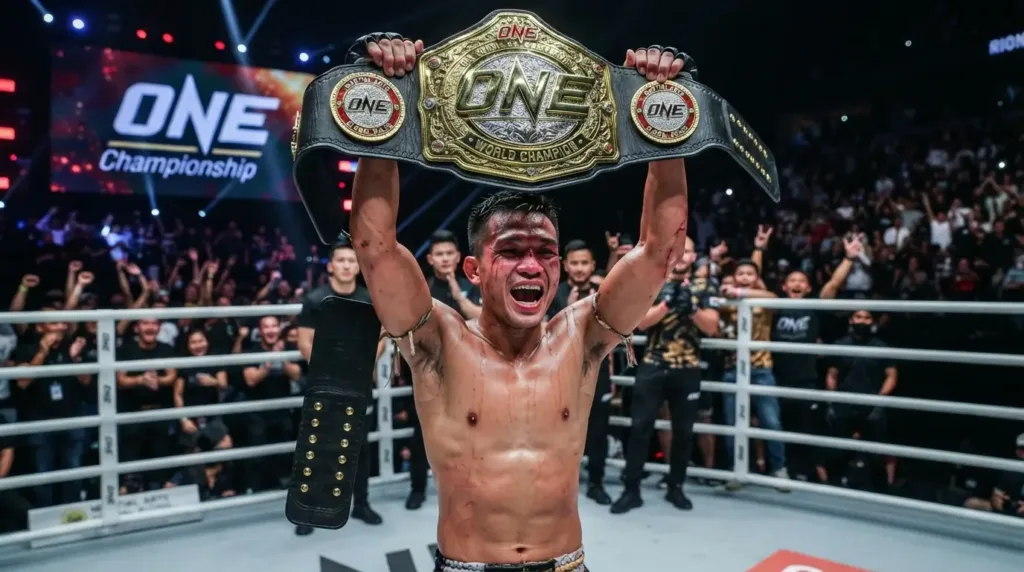
The ONE Championship belt is the world title handed to divisional champions inside ONE Championship, the Singapore based combat sports promotion that calls itself the Home of Martial Arts. It is widely considered one of the heaviest and most jewel covered titles in the sport, and the current version reportedly contains more than twenty six pounds of gold. If you’ve ever wondered why this particular belt gets so much attention online, this guide walks through where it came from, what it’s actually made of, and who has carried it.
I’ve spent years around replica championship belts, sourcing plates, comparing strap leather, and talking to collectors who want a piece that actually feels like the real thing. The ONE Championship belt comes up constantly in those conversations, mostly because it doesn’t look anything like a WWE title or a boxing belt. It’s worth understanding why.
ONE Championship began life as One Fighting Championship, founded on 14 July 2011 by Chatri Sityodtong and Victor Cui. The promotion held its first card at the Singapore Indoor Stadium that September, and it later dropped the word Fighting from its name in January 2015, becoming simply ONE Championship. Rather than sticking to mixed martial arts alone, the company grew to include muay thai, kickboxing, and submission grappling under one roof, which is part of why its belts couldn’t just represent one style of combat.
The organisation is based in Singapore, and it built its identity around Asian martial arts traditions rather than copying the American model set by promotions like the UFC. That cultural angle shows up directly in how the ONE Championship belt looks and how it gets presented to fans.
Backers including major investment firms helped the company grow well past its regional roots, and by 2018 it was already valued at over a billion dollars. That kind of financial backing matters when you are trying to understand the belt itself, since a promotion with that much capital behind it can afford to commission something far more elaborate than a typical regional title. Every time ONE stages a major anniversary card, the presentation of its championship belts tends to reflect just how much the company has grown since that first show in 2011.
Early ONE title fights date back to 2013, when the first Featherweight World Championship was contested, followed soon after by the Welterweight and Flyweight titles. Those early belts already leaned into an ornate, richly decorated look rather than the flatter, simpler plates seen in some Western promotions.
The version most fans recognise today debuted at ONE X in March 2022, a card built to celebrate the company’s tenth anniversary at the Singapore Indoor Stadium. CEO Chatri Sityodtong unveiled a completely new ONE Championship belt design that weekend, retiring the older belts and handing the new titles to the winners of five championship bouts on that card.
According to Sityodtong himself, the belt unveiled at ONE X contains roughly twenty six point four pounds of gold, a figure he shared directly with reporters at the announcement. That number alone puts it near the top of any list of the heaviest active title belts in combat sports today.
Part of that weight comes from a custom travel case created with luxury brand Tumi as part of a broader partnership, giving champions a way to transport and display the belt that matches its presentation on stage. From what I’ve seen working with belt materials myself, that kind of weight is unusual even for a flagship world title, since most promotions don’t want a belt so heavy it’s uncomfortable for a fighter to lift during a celebration.
The ONE Championship belt is built around a thick leather strap secured with ten studs, topped by a gold plated centerpiece set with a large number of mounted stones. Former CEO Victor Cui once described it as one of the richest prizes in the sport, built specifically to reflect the value the promotion places on martial arts tradition rather than just serving as a prop for photographs.
Compared to a typical UFC title, which favours a cleaner, more minimal look, the ONE Championship belt leans hard into ornamentation. It reads more like a ceremonial crown than a sports trophy, and that’s exactly the point, since it fits the promotion’s branding as the Home of Martial Arts. Anyone comparing belts across promotions will notice this one stands out almost immediately in photos.
Champions across ONE’s many divisions include names like Adriano Moraes in the flyweight ranks and Honorio Banario, an early featherweight titleholder. One of the more remarkable recent stories belongs to Smilla Sundell, who became the youngest titleholder in the promotion’s history after winning the strawweight muay thai belt while still a teenager.Because ONE runs championships across several disciplines rather than just MMA, its belt has been worn by wrestlers, muay thai specialists, kickboxers, and grapplers alike, giving the title a genuinely broad roster of champions compared to a single sport promotion.
Champions also tend to come from a much wider spread of countries than fans might expect, with titleholders hailing from Brazil, Thailand, the Philippines, Sweden, and beyond. That international mix is very much by design. Sityodtong has spoken often about wanting a promotion that represents the whole of Asia and, increasingly, the rest of the world, and the belt itself has become a symbol fans associate with that global ambition rather than any single country’s fighting style.
If you want a wider view of how championship belts differ across combat sports, our own guide to the history of MMA championship belts walks through the design choices made by the UFC, Bellator, and other major names in the sport. We also cover a promotion with a similarly bold, heavyweight approach to its titles in our piece on the
Bellator championship belt, which makes for an interesting side by side comparison with ONE’s own approach.
For fans who collect across multiple organisations, browsing our full range of MMA belts is a good starting point before deciding which style suits a collection best.
Genuine championship gold from ONE never leaves the promotion’s hands, so if you want to own something inspired by it, a replica is really your only route. A well made replica should copy the thick strap, the stud pattern, and the layered centerpiece rather than settling for a flat plate with a printed logo. That’s the same standard I apply when sourcing materials for any premium replica belt, regardless of which promotion inspired it.
Championship Belt UK builds custom pieces that can take design cues from titles like this one, using zinc alloy plating and genuine leather straps rather than the thin, lightweight versions sold as toys. Anyone chasing the look of the ONE Championship belt for a collection, a gift, or a themed event can request a build that leans into that same ornate, heavyweight style.
The current design uses a gold plated centerpiece mounted with a large number of stones, attached to a thick leather strap held by ten studs.
CEO Chatri Sityodtong stated the belt introduced at ONE X in 2022 contains about twenty six point four pounds of gold.
Title matches began as early as 2013 with the first Featherweight World Championship, though the design fans recognise today was introduced in 2022.
Chatri Sityodtong and Victor Cui founded the promotion, originally named One Fighting Championship, on 14 July 2011 in Singapore.
Based on publicly stated figures, the ONE Championship belt is considerably heavier and more densely decorated than the UFC’s current Legacy belt, which favours a lighter, more streamlined design.
The ONE Championship belt tells a clear story about what the promotion values: scale, spectacle, and a genuine respect for the martial arts traditions it grew out of. From its early days as a modest regional title to the twenty six pound masterpiece unveiled at ONE X, it has become one of the most talked about pieces of hardware in combat sports. Whether you are a fan tracking title reigns or a collector chasing the look for yourself, understanding its history makes the belt itself a lot more interesting to look at.


 Optimized by Seraphinite Accelerator